 DetailerGilde
Treatment
Car polishing. What it is, what it costs and who does it
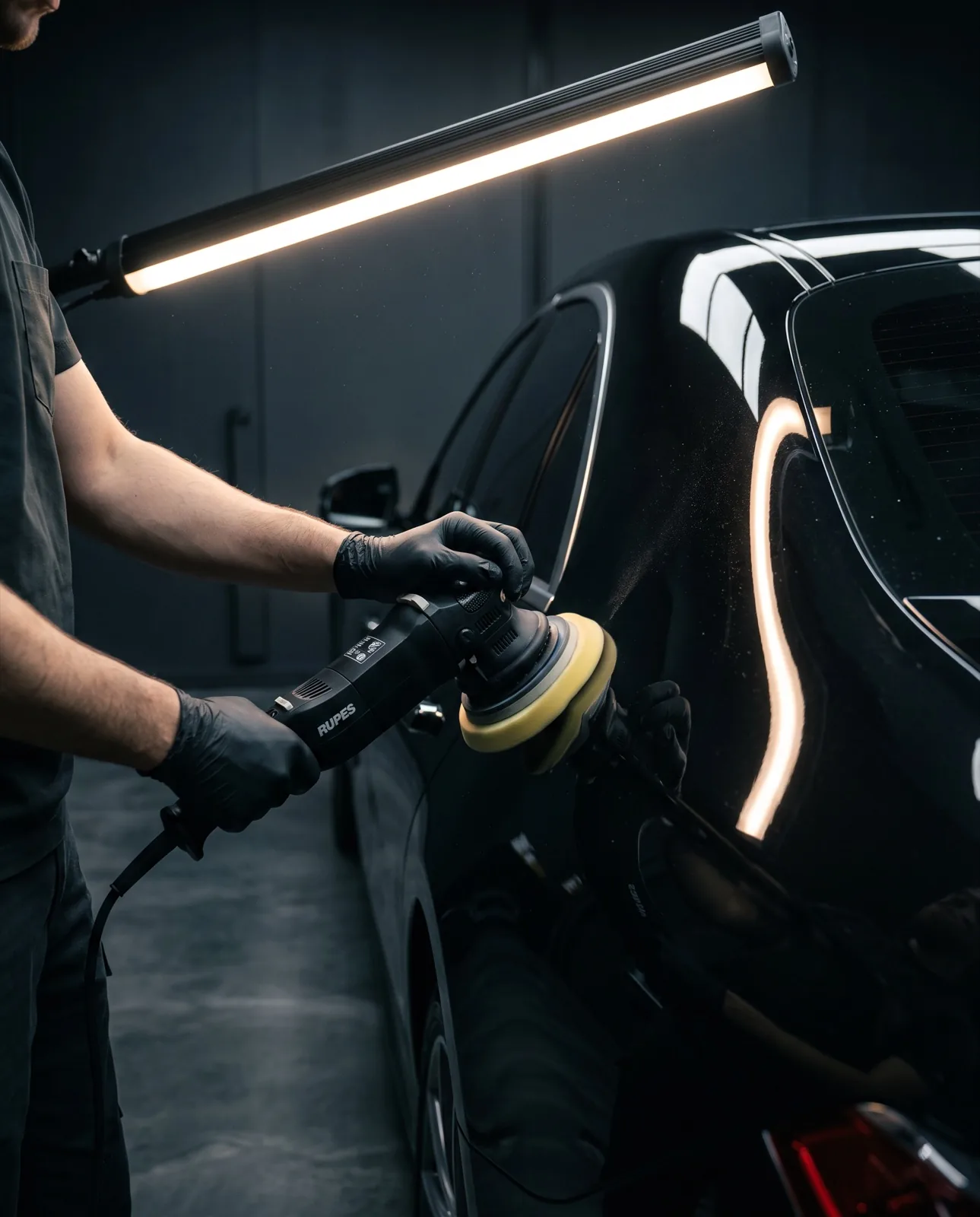
Polishing removes a microscopically thin layer of clear coat with a machine, down to the level where scratches and swirls disappear. It takes away, it does not add. That is why it makes paint look deep again but leaves it unprotected.
- From
- € 295
- Up to
- € 1.800
- Time without your car
- 1 working day
- All prices
- excl. VAT
How it works
Car polishing: what happens step by step
- 01
Wash, decontaminate and clay
Every particle left on the paint gets dragged through it on the first pass. Fallout is dissolved chemically rather than rubbed off, and this wash is part of the job rather than a separate charge.
- 02
Measure the paint
At several points per panel. Clear coat is usually around fifty microns and every correction takes a few of those away. This decides how hard anyone is allowed to work.
- 03
Assess under light
With an inspection lamp, in the dark. Fine circular marks are wash swirls; straight grooves come from somewhere else and need a different approach.
- 04
Correct
By machine, in one or more stages, wiping down and reassessing in between. Carrying on without checking is exactly how someone goes through the clear coat.
- 05
Refine and protect
A finer stage removes the marks left by the correction itself, otherwise you trade scratches for haze. Then a protective layer, because bare paint picks up its first swirls again within a few washes.
What it costs
Car polishing prices: what it costs at each level
Every level includes the one before it. The difference in price is not margin, it is the number of steps. All amounts exclude VAT.
- One stagefrom€ 295to € 550
For light swirls and dullness on paint that is otherwise sound. Removes most of what you see, not all of it.
Takes up to 8 hours - Two stagesfrom€ 550
A cutting stage and a refining stage. For paint with deeper swirls, where one pass would leave haze behind.
Takes 1 day - Three stagesfrom€ 800to € 1.800
For dark paint that has to be close to flawless. Deeper scratches are sanded out first and only then polished in three stages. Only worth it if the clear coat has the thickness left for it.
Takes 2 days
Frequently asked
What is car polishing?
Using a machine and an abrasive compound to remove a very thin layer of clear coat, down to the level where scratches and swirls are gone. Polishing takes material away; it does not add anything. In Dutch it is called polijsten.
How much does car polishing cost in the Netherlands?
One stage starts at €295 excluding VAT and runs to €550. Two stages start at €550, three stages at €800 and run up to €1,800 for a full car. What you need depends on what is in the paint, not on what you want to spend.
Is polishing the same as a wash and detail?
No, and this is the most common misunderstanding. A wash and interior clean starts at €99 and no machine touches the paint. The moment a machine with compound goes over the clear coat it starts at €295, because paint is being removed and that can only happen a limited number of times.
How often can a car be polished?
Clear coat is usually around fifty microns and every correction takes a few away. Three to five times in the life of a car is realistic. That is why the thickness gets measured before anything comes off, and why a good specialist sometimes says no.
What is the difference between polishing and paint correction?
Polishing works on what sits on the paint. Paint correction works on the paint itself, with abrasive paper, and is meant for orange peel and runs after respraying. Different work, more hours, and therefore more expensive.
How long does it take?
One working day. You drop it off in the morning and collect it at the end of the day, and that includes a two-stage job: more hours, not an extra day. Only three stages runs into a second day, and if a coating goes on top the car stays until it has cured.
Will every scratch come out?
No. If your fingernail catches in the scratch it goes through the clear coat and polishing will not remove it. Carrying on then does damage rather than good, and we say so.
Can I have it done if I do not speak Dutch?
Yes. Mention it in your request and we match you with a specialist who works in English. Most detailers around Amsterdam, Amstelveen and Eindhoven do, because a large part of their customers are internationals.